A picture’s history does not stop when the paint dries. Owners, viewers and institutions can attach new meanings to it. The challenge is to distinguish the scene we can see from the interpretations that developed around it.
Begin with the encounter
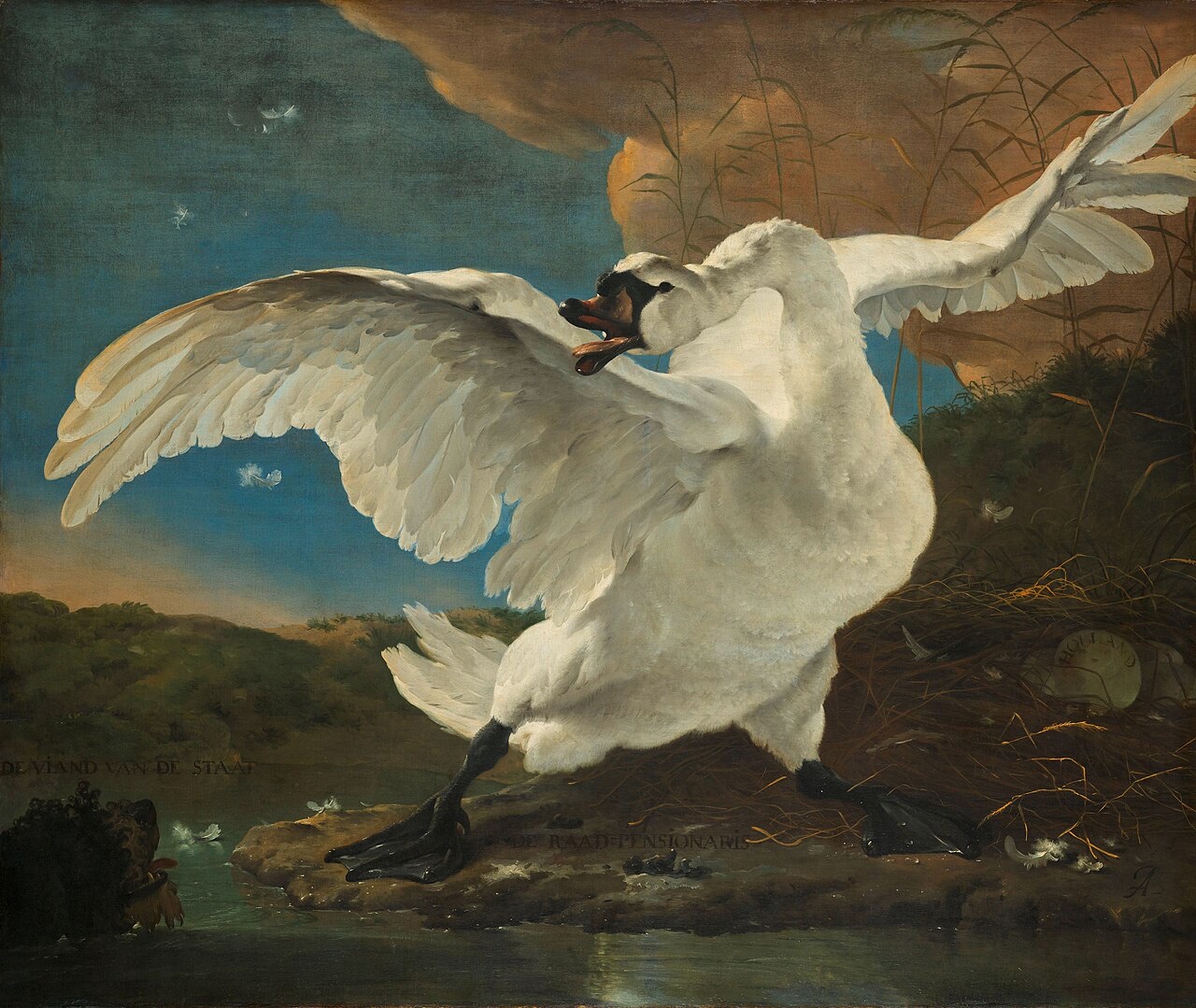
Jan Asselijn’s The Threatened Swan, dated around 1650, shows a swan defending a nest against a dog. The broad wings take up much of the canvas. Before reading further, identify the positions of the bird, eggs and dog. That gives you a visual account without requiring a symbolic explanation.
A meaning added by later viewers
The Rijksmuseum explains that the scene was later read as an allegory of the Dutch statesman Johan de Witt defending the country. This interpretation was attached to the work when it entered the Nationale Kunstgalerij, a predecessor of the Rijksmuseum, as its first acquisition in 1800.
Those are different moments in the life of the picture. A later reading is evidence of how a work was understood at that time; it should not automatically be treated as proof of the painter’s original intention. This distinction is useful far beyond this single painting.
Keep two kinds of notes
On one side of a notebook, describe visible details: the wings, the nest, the confrontation and the distribution of light. On the other, record information supplied by a collection entry or a historian. Keeping them separate makes it easier to see when an interpretation depends on knowledge outside the image.
Why a collection changes the conversation
Once a work enters a public collection, its position among other objects can influence how people encounter it. A display about animals may encourage one set of questions; a display about national history may encourage another. Neither makes the material object disappear. Both make the role of the viewer more visible.
Try looking before the title
Describe the scene in one sentence without a person’s name or a historical date. Then read the museum’s collection record. Add a second sentence explaining what the record contributes. The two sentences answer different questions.
Follow the evidence
Collection information and historical facts are grounded in the sources above. Looking exercises and commentary are our editorial contribution.