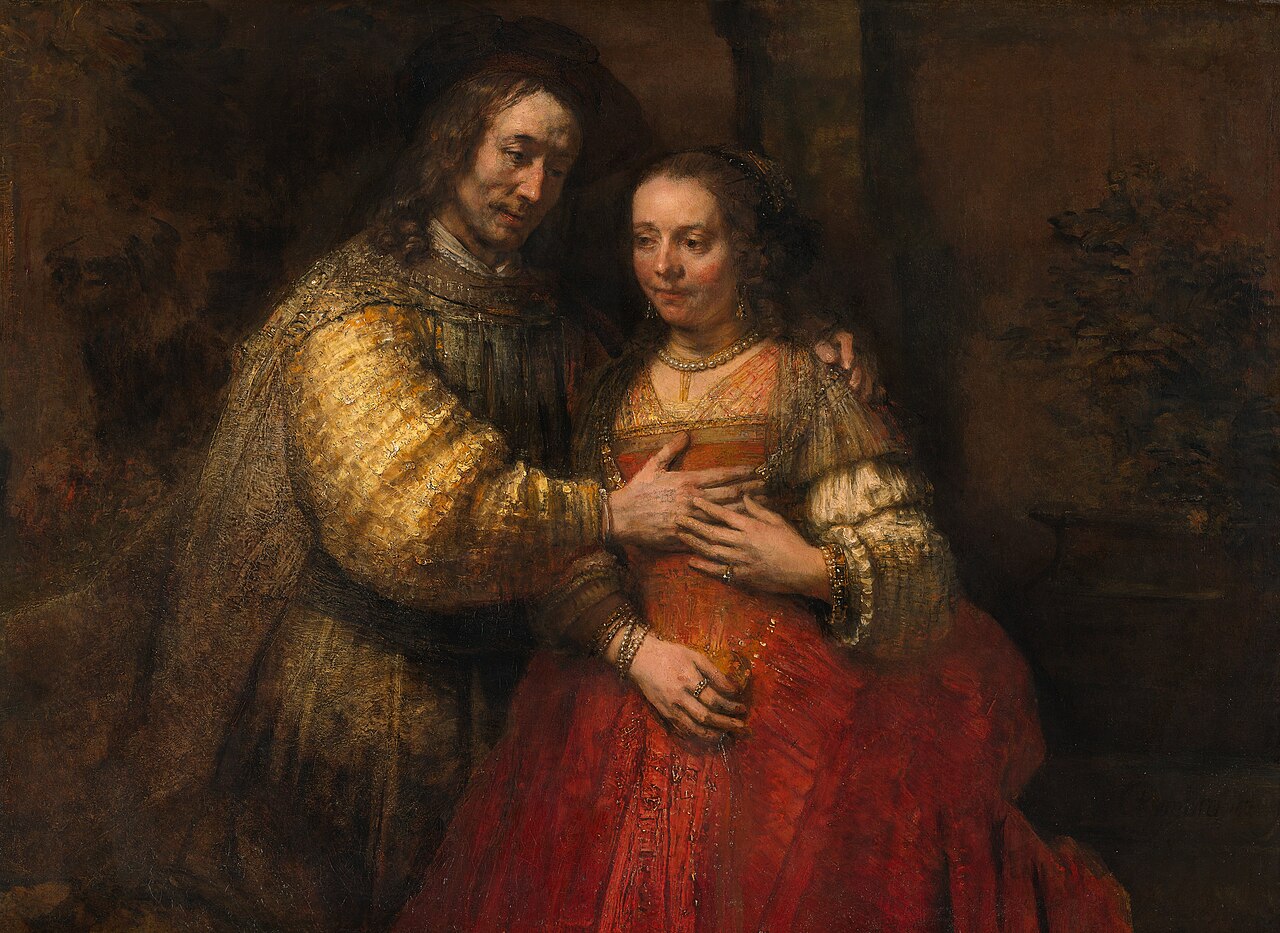
We often notice relationships in a picture before learning the names of its figures. A hand resting on another hand can communicate intimacy without telling us who the people are. Keeping that distinction open makes looking more precise.
A title with a history
The Rijksmuseum catalogues Rembrandt’s painting as Isaac and Rebecca, Known as “The Jewish Bride” and dates it to around 1665–1669. Its interpretation connects the figures to the biblical couple. The longer title carries information that the familiar short title does not.
Read the relationship first
Follow the hands and arms. Notice how touch connects the figures while their faces do not simply address the viewer. Describe those relationships before deciding on an emotion. “Their hands meet” is an observation; “they feel reassured” is an interpretation. Both can be useful if we know which one we are making.
Paint is also part of the subject
The museum highlights Rembrandt’s thick application of paint and his use of the brush handle to scratch into it. A reproduction can suggest these effects, but it cannot fully reproduce the surface, scale or changing light of a painting in a room.
Compare a hand with a passage of clothing. Are the edges equally sharp? Does one area seem more densely worked? The difference between a quietly rendered face and emphatic fabric can become part of the way we experience the scene, rather than a detail to identify and then ignore.
Leave room for uncertainty
A convincing painted relationship does not give us unrestricted access to private lives. Portraiture, storytelling and the expectations of an audience can overlap. When a label offers an attribution or an identification, notice whether it uses qualifications such as “probably,” “known as” or “attributed to.” Those words preserve distinctions that a short caption can easily lose.
Try a description in three lines
Write one line about touch, one about gaze and one about the surface of the paint. Only then add the title. This exercise separates what the picture offers directly from the information supplied by its record.
Follow the evidence
Collection information and historical facts are grounded in the sources above. Looking exercises and commentary are our editorial contribution.