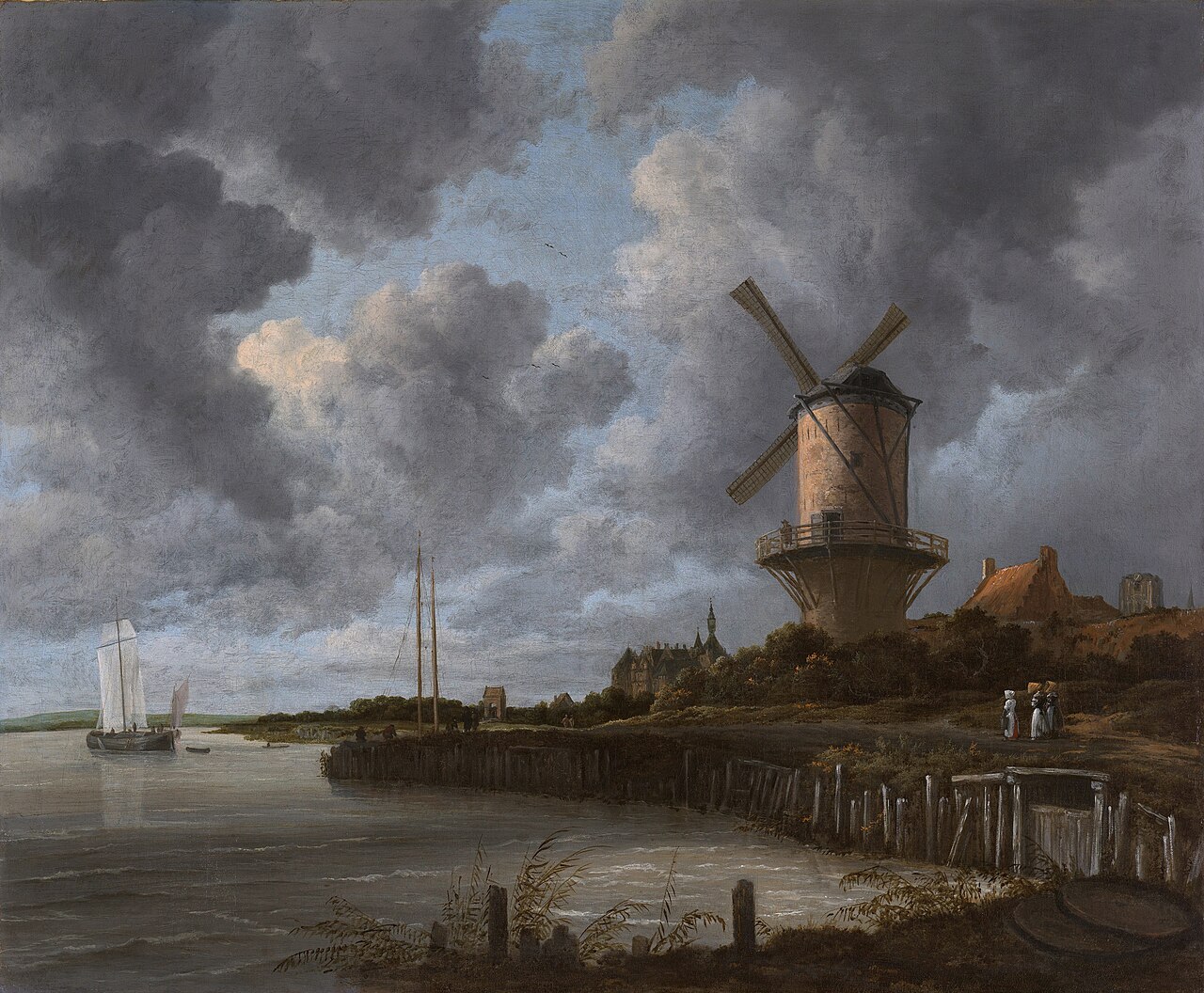
A landscape painting offers a way of arranging the world. Its horizon, light and scale direct attention before a viewer identifies the place. Looking at those decisions helps separate the painted image from the idea of a neutral record.
Where the sky begins
In Jacob van Ruisdael’s The Windmill at Wijk bij Duurstede, dated by the Rijksmuseum to around 1668–1670, the mill stands beside the River Lek. The museum describes a composition bringing together water, low land and an expansive sky. The church and castle belong to the same view, but their visual weight is very different.
Begin with the horizon rather than the mill. Notice how much of the picture lies above it. Then compare the dark cloud masses with the illuminated surfaces below. A building’s apparent importance depends on this arrangement as much as on its physical size.
A working place, a composed image
The river and the mill suggest a landscape used by people. Yet a painted scene does not explain every part of a region’s economy, engineering or daily life. Those questions need maps, documents and other kinds of evidence. A painting can prompt research without replacing it.
Try comparing the route your eye follows with the route a person could physically take through the scene. They need not be the same. Light, overlapping forms and the angle of a roof can make a visual path that a walker could never follow.
What this changes about looking
Calling an image “typically Dutch” can be a useful starting point, but it can also stop observation too soon. Ask which particular choices produce that impression. The answer may involve the balance of land and sky, the relationship between buildings and water, or a familiar subject made newly dramatic.
Try a two-minute comparison
Cover the sky with a sheet of paper held in front of the reproduction. Look at the lower part, then uncover the whole image. What happens to the scale of the mill and the mood of the scene? This is an editorial looking exercise, not a claim about the artist’s intention.
Follow the evidence
Collection information and historical facts are grounded in the sources above. Looking exercises and commentary are our editorial contribution.